
By Petros Koutoupis, Product Manager, VDURA , Feb 4, 2026 (LinkedIn Blog Post) –Parallel file systems such as PanFS to even pNFS frequently appear in conversations about scalable, high-performance storage, but despite the similar acronyms, they come from entirely different lineages, architectures, and design philosophies. PanFS is a vertically integrated, purpose-built parallel file system engineered to maximize performance and reliability across tightly coupled hardware and software. pNFS, on the other hand, is a protocol extension within the broader NFSv4.1 API, designed to provide parallelism through an open, standards-based interface that can be implemented by many storage vendors.
For architects planning large-scale AI clusters, HPC environments, data-intensive analytics platforms, or enterprise storage deployments, understanding how these two technologies diverge is critical. Both aim to deliver high-throughput, low-latency access to shared data at massive scale, yet they tackle the challenge from fundamentally different angles, one through deep integration and controlled architecture, the other through flexibility and vendor-agnostic extensibility. Appreciating these differences helps ensure the right fit for performance, operational simplicity, and long-term scalability.
Two Standards, Two Philosophies
PanFS is a proprietary parallel file system developed by Panasas, now VDURA, designed as a fully integrated hardware and software solution. As part of a tightly integrated experience, PanFS focuses on delivering predictable, high-performance storage with minimal administrative overhead. Its architecture is optimized for diverse technical workloads that demand high throughput, low latency, and robust data resilience. By handling much of the complexity internally, PanFS allows administrators to deploy and manage large-scale storage environments without extensive tuning, making it particularly well-suited for organizations seeking scalable, reliable performance for demanding applications such as high-performance computing, analytics, AI workloads, and media production.
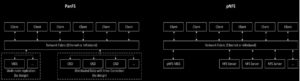
In contrast, pNFS (parallel NFS) is an open, standards-based extension to the widely used Network File System (NFS) protocol. First introduced in NFS version 4.1, pNFS redefines how clients interact with storage by separating metadata operations from actual data movement. This design allows clients to access data directly on multiple NFS servers simultaneously, bypassing the traditional bottleneck of routing all traffic through a single NFS server. Unlike PanFS, pNFS is not a file system itself, but a protocol that enables parallel I/O across multiple storage backends, supporting a range of architectures including block, object, and traditional file-based storage. By providing a standardized approach to distributed data access, pNFS offers flexibility and scalability for environments where multiple clients need concurrent, high-performance access to shared storage, while still relying on existing NFS infrastructure.
One of the biggest differences between PanFS and pNFS is the degree of integration. PanFS is a vertically integrated solution with hardware, software, networking, and fault-tolerance features designed to operate as a cohesive unit. This integration enables PanFS to guarantee consistent performance across nodes and workloads. pNFS, however, relies on underlying storage implementations created by different vendors, each with its own performance characteristics, data layouts, and resilience strategies. pNFS often requires careful planning, configuration, and ongoing management.
Inside the System
The Metadata
Metadata handling represents a major point of divergence between PanFS and pNFS. PanFS employs a highly optimized, distributed metadata architecture that separates metadata from actual data while intelligently distributing both across storage nodes. This design allows the system to dynamically place data based on factors such as object size, access patterns, and desired performance objectives, ensuring high throughput, low latency, and balanced resource utilization across the cluster.
On the other hand, pNFS relies on a centralized metadata server that provides clients with layout information describing where data resides. Once the client has this information, it can interact directly with the underlying storage targets for read and write operations. However, the performance and reliability of pNFS metadata operations are largely dependent on the design and implementation of the chosen backend storage system. Variations in vendor architectures, data layouts, and fault-tolerance mechanisms can impact how efficiently metadata operations are handled, making careful planning and tuning critical to achieving optimal performance in a pNFS deployment.
The File Data
Another fundamental difference between PanFS and pNFS lies in how they handle data layout and striping. PanFS treats files as objects and employs a sophisticated layout engine that automatically stripes data across multiple nodes. This engine takes into account the size of each file, access patterns, and performance objectives to determine the optimal distribution of data. By automating these decisions, PanFS eliminates the need for manual tuning and ensures predictable, high-throughput performance, even as storage clusters scale to larger sizes.
Alternatively, pNFS operates at the protocol level, providing a framework for communicating data layouts to clients but leaving the specifics of striping and distribution up to the underlying storage implementation. Each vendor or system integrator must design and implement their own data layout strategy, which can result in significant differences in performance, scalability, and resilience across pNFS-compatible systems. While this approach offers flexibility and allows organizations to leverage a variety of storage architectures, it also means that achieving consistent, predictable performance requires careful planning, testing, and optimization of the chosen backend storage.
Fault Tolerance
Fault tolerance is a core strength of PanFS, built directly into its integrated architecture. The system leverages erasure coding, self-healing, and per-file redundancy to ensure that data remains protected even in the event of hardware or node failures. These mechanisms operate automatically, continuously monitoring the cluster and rebalancing or reconstructing data in a highly parallel fashion. This approach minimizes performance disruptions and ensures that workloads can continue uninterrupted, even during component failures or maintenance operations.
In contrast, fault tolerance in pNFS is not defined by the protocol itself. Instead, it relies entirely on the capabilities of the underlying storage system chosen by the vendor or system integrator. Some pNFS implementations may offer sophisticated resiliency features such as replication, erasure coding, or automated recovery, while others may provide only basic protection, leading to significant variability in reliability and recovery performance. As a result, achieving robust fault tolerance in a pNFS environment often requires careful selection of backend storage, thoughtful configuration, and ongoing operational oversight.
Performance
Performance consistency is one of the areas where PanFS stands out. Because the system is built as a unified appliance, it avoids “noisy neighbor” scenarios and unpredictable slowdowns that can occur when storage subsystems from different vendors are combined. pNFS performance is more variable. While it can scale effectively in the right environment, performance depends heavily on the quality of the storage implementation, the metadata server design, and the network fabric.
Workload suitability also varies. PanFS is well known in HPC, scientific computing, and research environments where high throughput and mixed workloads must run concurrently without disruptive performance drops. Its architecture excels at workloads involving large files, many small files, or complex I/O patterns. pNFS is versatile and can support a wide range of use cases, but its performance in technical computing depends on the underlying storage vendor’s implementation and tuning.
In AI and machine learning environments, PanFS provides strong performance for training data pipelines, parallel ingest, checkpointing, and mixed workloads that combine small and large files. pNFS can also support AI workloads but may require additional tuning or specialized hardware depending on the implementation.
Scalability
Scalability is another key area where PanFS and pNFS diverge. PanFS achieves growth through the addition of integrated storage blades, each of which seamlessly joins the cluster and automatically participates in data distribution, load balancing, and redundancy operations. This tightly coordinated approach ensures that capacity and performance scale linearly, making it predictable and straightforward for administrators to expand storage without complex reconfiguration or tuning.
By comparison, the scalability of pNFS is largely determined by the capabilities of the underlying storage system. Again, because pNFS is a protocol rather than a fully integrated platform, it relies on the backend architecture to manage metadata distribution, data layout, and direct client access. As a result, some pNFS implementations can scale very effectively under high parallel workloads, while others may experience bottlenecks or uneven performance as the number of clients or the volume of data grows. Achieving consistent, high-performance scalability with pNFS often requires careful planning, testing, and optimization of the chosen storage infrastructure.
Management
Management complexity also differs sharply. PanFS focuses on simplified, appliance-like management tools that minimize the need for tuning or deep file system expertise. Administrators often report that PanFS requires less hands-on intervention even as clusters expand. pNFS deployments typically involve more configuration work, especially in environments where the metadata server, storage devices, and network infrastructure come from different vendors or require custom tuning for optimal performance.
Choosing the Right Path
In conclusion, PanFS and pNFS both aim to deliver high-performance, scalable shared storage, but they approach the challenge from fundamentally different angles. PanFS offers a fully integrated, appliance-based solution where hardware, software, and networking are designed to operate as a cohesive whole. Its tightly coupled architecture ensures predictable performance, built-in fault tolerance, automated data distribution, and simplified management, making it particularly well-suited for demanding environments such as HPC, AI, and data-intensive analytics. By handling complexity internally, PanFS allows organizations to scale confidently without extensive tuning or ongoing intervention.
pNFS, by contrast, is a flexible, standards-based protocol that provides parallel access to a wide range of storage backends. While this openness enables interoperability and vendor choice, the performance, scalability, and resilience of pNFS deployments depend heavily on the design of the underlying storage system. Organizations adopting pNFS can tailor solutions to specific needs, but doing so often requires careful planning, testing, and tuning to achieve consistent results. Ultimately, the choice between PanFS and pNFS hinges on organizational priorities: whether the emphasis is on turnkey reliability and predictable performance or on openness, flexibility, and the ability to integrate heterogeneous storage infrastructures.
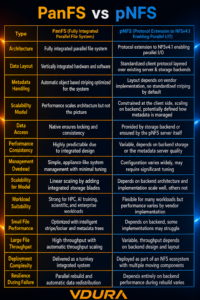
PanFS vs. pNFS Comparison Table
About the Author
Petros Koutoupis has spent more than two decades in the data storage industry, working for companies which include Xyratex, Cleversafe/IBM, Seagate, Cray/HPE and now, VDURA. In addition to his engineering work, he is a technical writer and reviewer of books and articles on data storage and open-source technologies and has previously served on the editorial board of Linux Journal magazine.
About VDURA
VDURA builds the world’s most powerful data platform for AI and high-performance computing, blending flash-first speed with hyperscale capacity and 12-nines durability, all delivered with breakthrough simplicity. Visit vdura.com for more information.
The future of HPC and AI is still being written and VDURA is at the forefront, driving innovation.