
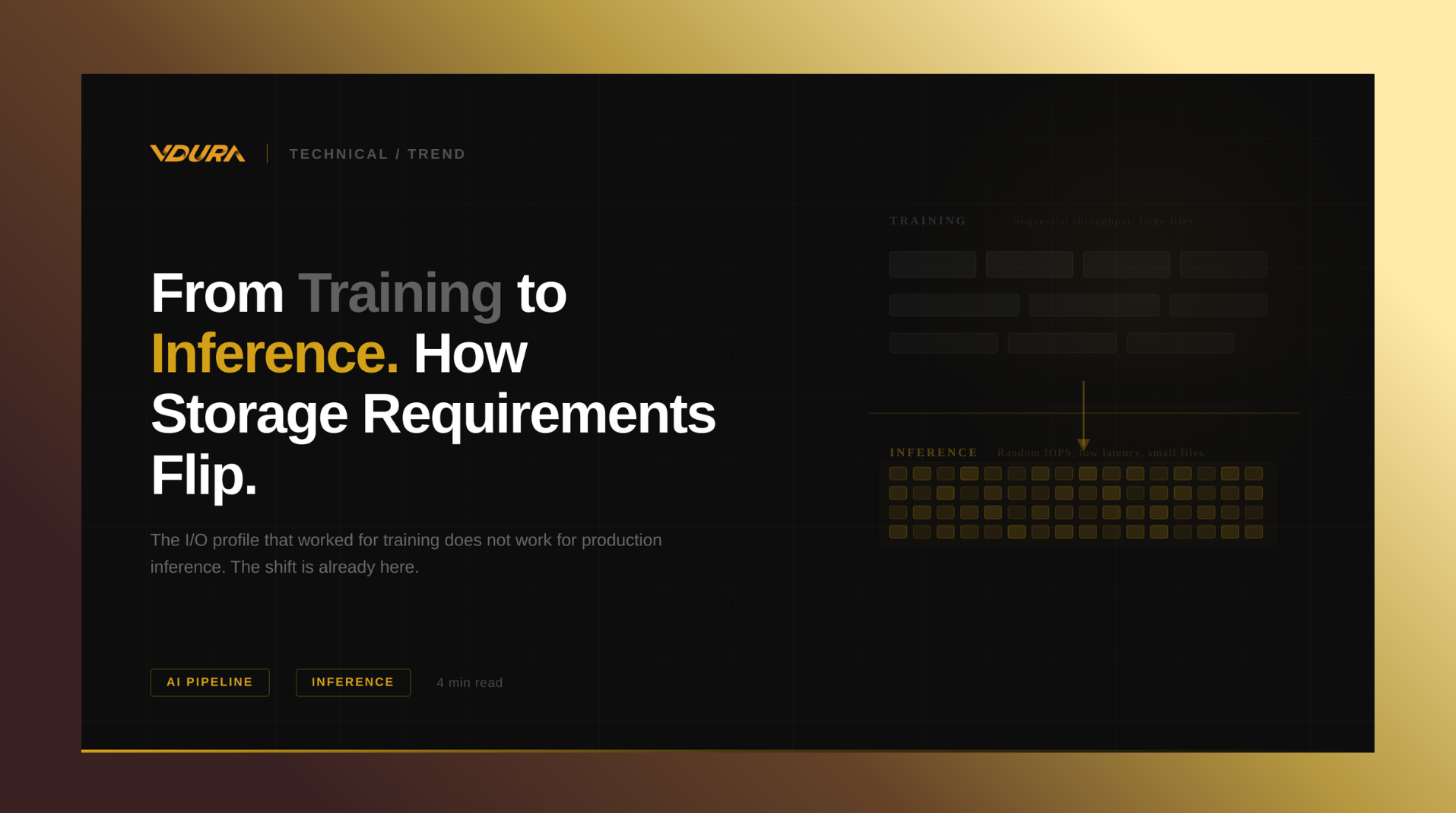
For most of the AI infrastructure buildout, storage was optimized for one thing: feeding training runs. The playbook was straightforward. Massive sequential throughput. Large file reads. Burst checkpoint writes measured in terabytes. If the storage system could keep GPUs saturated during training and write checkpoints fast enough to minimize idle time, it was doing its job.
That playbook is still relevant. But in 2026, it is no longer sufficient. The center of gravity in AI infrastructure is shifting from training to inference, and the storage requirements between the two are not just different. They are, in important ways, opposite.
The Shift Is Already Happening
Inference now represents 80 to 90% of AI compute usage in production environments. Training builds the model. Inference is where the model earns revenue. Every chatbot response, every recommendation engine query, every agentic AI workflow that reasons across documents and tools in real time is an inference workload. And the economics of the industry are shifting accordingly.
Unified AI Hub reports that 2026 is the year the AI world moves from building larger training clusters to deploying continuous inference, the real workhorse of practical AI. Unlike training, which runs in scheduled bursts, inference is persistent, distributed, and always on. It does not stop. It does not batch. It serves requests at the speed users expect, or it fails.
McKinsey’s analysis of hyperscaler strategies confirms the same trend: while training costs are capital-intensive and hard to link to commercial impact, inference costs are recurring and directly tied to revenue generation. The infrastructure that matters most is no longer the cluster that trained the model. It is the infrastructure that serves it.
How the I/O Profile Flips
Training workloads are dominated by large sequential operations. Reading multi-terabyte datasets in streaming fashion. Writing checkpoint files that can span hundreds of gigabytes to terabytes per save. The storage metric that matters most is raw throughput: how many gigabytes per second can you sustain across thousands of parallel streams.
Inference flips that profile. The dominant pattern becomes small, random, latency-sensitive reads at massive concurrency. Model serving generates concurrent access across parameters and embedding tables. RAG workflows query vector databases and retrieve documents in real time. Agentic AI systems pull context from knowledge bases while reasoning across multi-step tasks. The metric that matters is no longer throughput alone. It is IOPS and tail latency under load.
HyperFRAME Research’s 2026 enterprise survey found that inference environments prioritize metadata performance, parallel access, and predictable latency under constant query pressure. These are closer to high-performance data services than traditional storage tiers, which is why infrastructure designed for training workloads often struggles when inference goes to production.
The Metadata Problem Nobody Planned For
Training workloads tend to be metadata-light. You are reading large files sequentially. The metadata system is not under significant pressure. Inference changes that equation entirely.
Production inference generates continuous metadata activity. Computer Weekly notes that agentic AI, which is largely an inference-phase phenomenon, requires storage that can handle a wide variety of data types with low latency and the ability to scale rapidly. Context retrieval, model versioning, feature store lookups, embedding index queries, and real-time access policy enforcement all generate metadata operations that persist long after training ends.
Blocks & Files observes that inference is not episodic like training. It is persistent, distributed, and shared. Models may live close to accelerators, but the data they rely on often does not. KV cache persistence, which NVIDIA’s ICMS architecture addresses at the hardware level, is an early indicator of how inference architectures are evolving: the assumption that data state is disposable is being replaced by the reality that context reuse is critical to inference economics.
Why One Architecture Cannot Serve Both
The fundamental tension is this: training optimizes for sequential throughput while inference optimizes for random IOPS and latency. Training tolerates seconds of I/O latency during data loading phases. Inference demands sub-millisecond response times for production SLAs. The scaling dimensions differ: checkpoint bandwidth scales with model size, while inference IOPS scales with concurrent request count.
A storage architecture that was designed exclusively for training throughput can struggle badly when inference workloads arrive. Metadata systems that were adequate for large-file sequential access buckle under the pressure of billions of small, random operations. Tiering policies designed for hot training data and cold archive do not map to the always-warm, constantly accessed datasets that inference depends on.
The organizations that planned for this transition built storage platforms with metadata systems capable of handling billions of operations per second, not just high-bandwidth sequential I/O. They designed for mixed workload profiles where training and inference coexist on the same infrastructure. And they ensured that their storage could deliver predictable low latency under concurrent load, because inference SLAs are measured in milliseconds, not megabytes.
The Takeaway
The AI industry spent three years optimizing storage for training. Now the revenue is in inference, and the storage requirements have flipped. The throughput numbers that won training benchmarks do not guarantee that your storage can serve inference at production scale. The organizations leading the transition are the ones that asked the harder question early: can this platform serve both workloads simultaneously, with predictable performance, without requiring a second storage stack?
If inference is where AI earns its return on investment, then inference-ready storage is not a future consideration. It is a present requirement. And the clock is already running.