
By Petros Koutoupis, Product Manager, VDURA , June 2, 2026 – When neocloud operators and AI factory builders evaluate storage, the conversation almost always starts with performance specs and price per terabyte. Those are important conversations. But in 2026, there is a prior question that determines whether everything else matters: what happens to your infrastructure when the hardware your vendor depends on becomes scarce, expensive, or unavailable?
That question stopped being theoretical sometime around mid-2025. It is now the defining constraint in AI infrastructure planning, and the operators who picked storage architectures with the wrong answer are living through the consequences in real time.
The Market Just Changed the Rules
Let us begin with the indisputable facts:
Between Q2 2025 and Q1 2026, the price of a 30TB enterprise SSD surged 472%, from $3,062 to $17,500. Over the same period, HDD pricing rose 35%. Those are not the same curve. They are not even the same neighborhood.
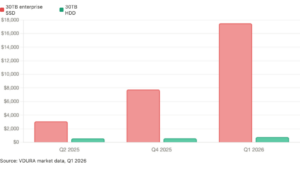
The reasons are structural, not cyclical. The three largest memory manufacturers on earth, Samsung, SK Hynix, and Micron, have been systematically reallocating cleanroom capacity away from conventional NAND and toward High-Bandwidth Memory, which commands far higher margins in the AI accelerator market. Every wafer that goes to an H100 or B200 is a wafer that does not produce enterprise SSDs. Phison’s CEO stated plainly at the end of 2025 that “every NAND manufacturer told us 2026 is sold out.” Kioxia confirmed its entire NAND flash production for 2026 was spoken for before the year began. Lead times for high-capacity enterprise SSDs have extended to over twelve months in some configurations, meaning infrastructure projects that were not planned and ordered well in advance face indefinite delays.
This is not a temporary spike to wait out. Industry analysts and memory manufacturers alike expect tight supply conditions to persist until at least 2027, with no significant new fab capacity coming online to relieve the pressure in the near term.
For infrastructure operators, there is only one sensible response to a market like this: make sure your architecture does not make the problem worse.
What “Proprietary Hardware” Actually Means When Supply Chains Break
The phrase “software-defined storage” has been used loosely enough in vendor marketing that it has nearly lost its meaning. So,let’s be precise about what actually distinguishes architectures in a supply-constrained environment, and why the distinction matters so much right now.
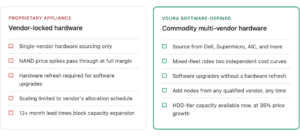
A genuinely software-defined storage platform runs its software on commodity, multi-vendor hardware. The software does not care whether the server came from Dell, Supermicro, AIC, or another qualified vendor. You can source nodes from whichever supplier has inventory at the price and lead time that works for your deployment. When one supplier faces allocation constraints, you go to another. The cluster keeps running. The economics stay competitive. The architecture itself provides a hedge against commodity volatility.
A proprietary appliance-based architecture works differently. The vendor designs purpose-built hardware: specific chassis, specific NVMe enclosures, specific controller configurations. Their software is optimized for, or in some cases dependent on, that hardware. When you need to expand, you need their hardware. When their hardware faces supply constraints, you share their supply chain problem. When their hardware prices rise because input costs rose, you absorb that increase because you have no alternative source. Your procurement team’s leverage is effectively zero.
This distinction was largely academic when NAND was cheap, and lead times were short. In today’s market, it is the difference between infrastructure that can scale on your timeline and infrastructure that scales on your vendor’s allocation schedule.
Three Risks That Proprietary Hardware Creates Right Now
Risk 1: You Inherit Your Vendor’s Supply Chain Position
When your storage runs on a vendor’s proprietary appliance, your ability to add capacity is bounded by their ability to ship hardware. In a market where enterprise SSDs carry twelve-month lead times and NAND allocation is spoken for through 2026, that is a meaningful constraint. Operators trying to onboard new GPU tenants, expand cluster capacity, or respond to demand spikes are discovering that their storage vendor’s hardware timeline is not their timeline.
Customers and resellers across the all-flash storage market have reported stalled deals and requotes running two to three times higher than original pricing. This is not a negotiation problem. It is an architecture problem. Vendors whose software is tightly coupled to proprietary all-flash hardware have no structural mechanism to absorb commodity shocks on behalf of their customers. They pass them through, at margin.
Risk 2: Your Storage Budget Is Now Hostage to a Single Commodity
When neocloud infrastructure was being built in 2021 and 2022, storage represented roughly 10% of the total infrastructure budget. The GPU arms race dominated the conversation, and storage was treated as a solved problem. That math has collapsed. In all-flash deployments today, storage is trending toward 20 to 30 percent of the total infrastructure budget, and it is the fastest-growing line item in the stack.

Consider a concrete example: a 25-petabyte deployment delivering 1,000 GB/s of throughput. Priced on an all-flash architecture, that deployment cost approximately $8.5 million in Q2 2025. By Q1 2026, nine months later, the same all-flash configuration repriced to $24.54 million. Not because the workload changed. Not because the performance requirements changed. Because NAND prices changed, and an all-flash architecture has no mechanism to absorb that shift other than passing the cost to the operator.
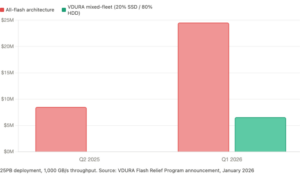
An operator running a mixed-fleet architecture priced the equivalent configuration at $6.56 million in Q1 2026. That is a real delta. In a business where GPU rental margins are already thin and competition is intensifying, a storage cost structure that can triple in nine months is not a manageable variable. It is an existential threat to unit economics.
Risk 3: Hardware Refresh Cycles Are Dictated by the Vendor, Not Your Roadmap
Appliance-based storage architectures bind hardware and software refresh cycles together. When a vendor releases a new appliance generation, the migration path for existing customers typically involves new hardware procurement rather than simply a software update. This creates forced capital events on the vendor’s product roadmap timeline rather than on the operator’s business timeline.
In a supply-constrained market, these forced refresh cycles are especially damaging. Operators who planned a capacity expansion around a vendor’s roadmap announcement may find that the new hardware they need is not available on the timeline they need it. The result is a gap between what the business promised tenants and what the infrastructure can deliver, which translates directly into SLA risk and customer churn.
What Software-Defined on Commodity Hardware Actually Unlocks
VDURA’s HYDRA architecture was built around a different set of assumptions, ones that look increasingly prescient given where the market has landed.
Supply chain optionality as a first-class feature. HYDRA runs on commodity, multi-vendor hardware: Dell, Supermicro, AIC, and any roadmap-certified server vendor. Storage nodes can be sourced from whichever supplier has availability at competitive pricing. When one vendor faces allocation pressure, operators source from another without rearchitecting anything. The software layer is hardware-agnostic by design, which means the procurement team’s options stay open regardless of what any single vendor’s supply chain is doing.
This is not a theoretical benefit. It is the practical difference between an operator who can onboard a new tenant cluster next month and one who is waiting for an appliance backorder to clear.
Mixed-fleet intelligence that reduces NAND exposure structurally. HYDRA natively supports mixed-fleet configurations, treating NVMe SSDs (TLC and QLC) for performance-critical tiers and SATA HDDs (CMR, SMR, HAMR) for capacity tiers as a single unified system rather than two separate architectures bolted together. Flash is used where flash latency is needed: hot checkpoint writes, active training data, inference-class reads. HDDs carry the bulk capacity workload where sequential throughput at HDD speeds is entirely adequate and where paying flash prices delivers zero additional value to the workload.
The result is a storage cost structure that rides two independent commodity curves. When NAND spikes, the HDD portion of the fleet is unaffected. When HDD density improves, and the hyperscaler-driven HDD roadmap is delivering density improvements at a pace not seen in years, HYDRA customers benefit without a forklift upgrade. The flash-to-HDD ratio can even be rebalanced dynamically through online cluster expansion as workload profiles and commodity economics evolve over time.
At the platform level, HYDRA delivers up to 75 GB/s reads and 50 GB/s writes per flash node, exceeds NVIDIA and AMD GPU storage performance guidelines, and achieves more than 40% flash efficiency. That means operators get more usable performance from their flash investment than all-flash architectures that don’t intelligently tier workload placement.
Upgrades on the operator’s terms, not the vendor’s. Because VDURA is software-defined, platform upgrades are software operations. No hardware change. No migration project. No vendor-scheduled maintenance window that conflicts with tenant SLAs. No capital event triggered by a vendor’s product cycle.
Operational simplicity that scales with lean teams. Automation and open APIs handle day-two operations, so small infrastructure teams can manage large deployments without dedicated storage administrators for every system. Adding capacity is as straightforward as lighting up additional nodes: no downtime, no complex rebalancing operations, no professional services engagement required for routine expansion.
The Proof Point the Hyperscalers Already Sent
There is an argument sometimes made that all-flash, purpose-built appliances represent the premium, high-performance choice, and that software-defined mixed-fleet architectures are a cost compromise.
The hyperscalers settled this debate without meaning to.
Google, Microsoft, Amazon, and Meta do not run proprietary storage appliances. They run commodity hardware with software they built themselves. And the specific media they are buying at hundreds-of-exabytes scale right now is not all-flash. The drive classes that Western Digital and Seagate reported record hyperscaler demand for in their most recent earnings, with contracts extending to 2028 and 2029, are high-density HDDs paired with NVMe flash in software-defined, mixed-fleet architectures.
This is not a coincidence. The world’s largest and most sophisticated AI infrastructure operators arrived at this architecture not because it was cheap, but because it was correct. Software-defined mixed-fleet provides the supply chain flexibility, the independent commodity cost curves, and the operational simplicity that running AI at scale actually demands. The hyperscalers built it themselves because they had to. VDURA built it so that every neocloud and AI factory operator can access the same architecture without needing a hyperscaler-scale engineering team to construct it.
The real premium option is not the one that looks most like a purpose-built appliance. It is the one that looks most like what the world’s best infrastructure operators actually run.
Five Questions to Ask Your Storage Vendor Before You Sign
The architecture gap between software-defined commodity platforms and proprietary appliance-based systems is real, but it does not always surface in vendor conversations unless you know what to ask. These questions cut through the marketing:
- Can I source your hardware from multiple independent vendors?If the answer is “our certified hardware” or “our appliance,” you are inheriting their supply chain. If the answer is Dell, Supermicro, AIC, and other standard server vendors, you have optionality.
- If NAND prices increase 50% next quarter, what happens to my cost to expand?A genuinely mixed-fleet architecture absorbs NAND price shocks on the HDD-tier capacity. An all-flash architecture passes them through entirely. Ask for a concrete number.
- Can you upgrade your software without requiring a hardware change on my end?If the answer involves a migration, a new appliance generation, or a professional services engagement, you are bound to their hardware refresh cycle. Online software upgrades with zero downtime are a software-defined capability, not an appliance capability.
- What percentage of my actual workload requires flash-class latency,and am I paying for flash on the rest?Most AI training and inference workloads require flash performance on 20 to 30 percent of their total data footprint. Bulk training datasets, model checkpoints after they leave the hot tier, and cold inference data do not need NVMe latency. Paying flash prices for those bytes is a structural overpay.
- If your hardware lead times extend to 12 months, what is my path to adding capacity in30 days?This question does not need elaboration. The answer tells you everything about how exposed your infrastructure is.
The Architecture Decision Is a Multi-Year Commitment
Storage architecture decisions are not made annually. The platform you select today will be running your AI workloads in 2027, 2028, and beyond, through whatever commodity cycles, supply disruptions, and workload evolution that period brings.
The supply chain environment of 2026 has made something visible that was always true but easy to ignore when NAND was cheap: architecture that chains your cost structure and your scaling options to a single commodity or a single vendor’s hardware roadmap is not a premium choice. It is a concentration risk.
The operators who are navigating today’s environment with the most agility are the ones who made a different architectural bet before the current constraints made it obvious why that bet was right: software-defined, commodity-hardware, mixed-fleet.
The window to make that choice before the next commodity shock is always now.
For the most up-to-date Storage System Cost Calculator, visit: https://www.vdura.com/flash-volatility-index-and-storage-economics-optimizer-tool/
About the Author
Petros Koutoupis has spent more than two decades in the data storage industry, working for companies which include Xyratex, Cleversafe/IBM, Seagate, Cray/HPE and now, VDURA. In addition to his engineering work, he is a technical writer and reviewer of books and articles on data storage and open-source technologies and has previously served on the editorial board of Linux Journal magazine.
About VDURA
VDURA builds software-defined data infrastructure for AI factories and neocloud operators. HYDRA, VDURA’s mixed-fleet parallel file system architecture, runs on commodity multi-vendor hardware and delivers flash-class performance with hyperscaler-grade economics. Learn more at vdura.com.