
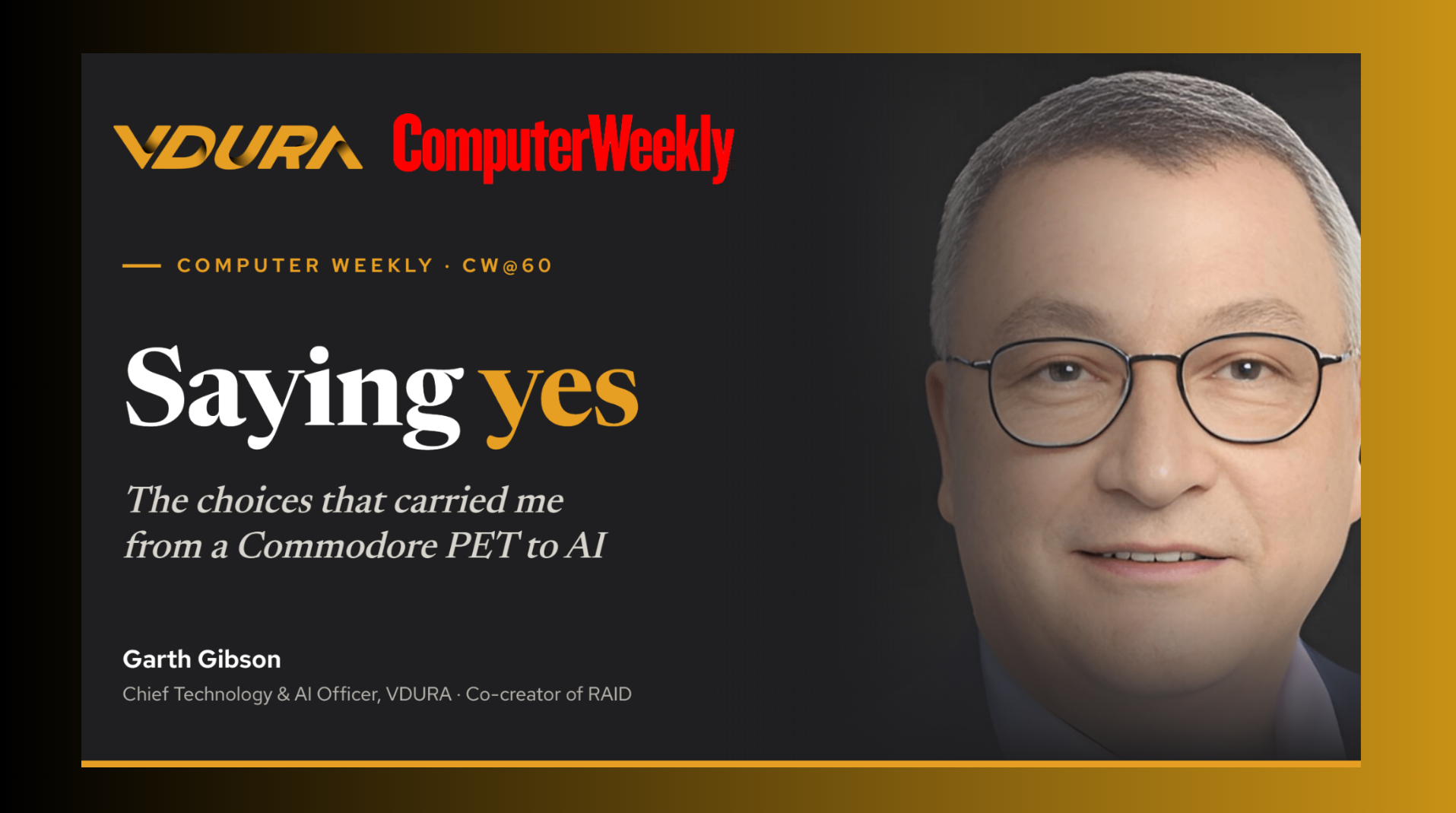
Source: Computer Weekly, Sept. 22, 2026 – In 1978, I was 18 years old, finishing high school in a small town north of Toronto, and holding university offers in three subjects – physics, engineering and computer science. I picked computer science for a simple reason – I thought it might lead to the most creative changes in society in my lifetime.
Nearly 50 years on, I would say the hunch held up. Though I concede it is no longer a slam dunk, quantum technology and gene engineering are still in the running. But Moore’s law, Jensen’s gaming cards and Geoff Hinton’s backpropagation make a good case for computer science.
It was a strange bet at the time. My parents were teachers who had never touched a computer. In 1978, the IBM PC was still three years away, and about the only place an ordinary person encountered computing was at the bank, where the tellers had terminals and the first cash machines were appearing.
My own hands-on experience amounted to tinkering with a friend’s Commodore PET after school. But that was enough. What drew me in was the blank sheet. A field so new that almost everything worth doing hadn’t been done yet. My parents didn’t resist. Their view was – you want to go to university, and that’s a good thing.
A sight of things to come
I earned my bachelor’s degree in applied mathematics at the University of Waterloo, Ontario and it was there, in the mid-1980s, that I got my first real look at what was to come – an account that let me send email to friends around the world. In 1985, email was largely unknown. The internet is still, I think, the biggest change technology has made to how we live, even if I maintain to this day that typing on a glass screen was a step backwards.
After graduating, I was working in telecommunications, half-heartedly weighing up graduate school, when two phone calls arrived. One was from a professor at Carnegie Mellon who wanted me to work on legged robots. The other was from David Patterson at Berkeley, recruiting students to help build a complete high-performance computer system, part of the project that made Reduced Instruction Set Computing (RISC) famous.
Legged robots sounded like mechanical engineering; RISC sounded like computer science. So, I said yes to Patterson and moved 3,000 miles from central Canada to the west coast of California. Berkeley was also a wonderful place to be a 24-year-old.
Glamorous problems
In 1987, I needed a PhD topic. The glamorous problems on the project all seemed to have been taken, and almost nobody was doing serious research on high-performance storage, so I took it. The timing turned out to be everything.
Storage then meant washing-machine-sized drives designed for mainframes. But the PC had created demand for small, cheap disks with a standard interface, SCSI, and it struck us that if you put enough of them together, you could beat the washing machine on performance and reliability.
“If I were 18 again today, I would choose AI because it feels exactly the way computing felt to me in 1978 – a green field, low-hanging fruit everywhere, the future visibly unwritten”
Garth Gibson

That idea became RAID – redundant arrays of inexpensive disks – and in 1988, David Patterson, Randy Katz and I published the RAID paper.
The moment I knew RAID mattered wasn’t about seeing a citation count. It was a Seagate person walking through our door with a photocopy of the technical report before the work had even appeared in the major academic venues, saying their customers wanted to buy this now.
And yet the low point happened after the high. In 1990, I was writing my dissertation on the graveyard shift, arriving at four in the afternoon and leaving at four in the morning, my only daily engagement the department secretaries at my day’s start. Two-and-a-half years on from the paper, I couldn’t yet see any real commercial success, and I remember thinking, why am I doing this? Who needs a PhD?
But about a year later, RAID was everywhere, the ACM recognised my dissertation among the best of its year, and the market it created grew to something like $10bn.
The industry even quietly renamed the “I” from “inexpensive” to “independent” disks; nobody wanted to sell something labelled cheap. The lesson I take from that time is how close together the lowest point and the breakthrough can sit.
Stop hiding
The second yes was to HT Kung, who recruited me to Carnegie Mellon after my PhD. There, I became convinced that storage needed to stop hiding inside file servers and become a first-class citizen of the network.
That conviction became the network-attached secure disks (NASD) project in 1995, and when its team of graduates scattered, the ideas went with them – into the first specification of what became Lustre, into the first versions of the Google File System, whose paper became the blueprint for Hadoop’s HDFS, and into Panasas (now VDURA), the company I co-founded to build the PanFS parallel file system and propose pNFS as a standard.
When Roadrunner, the world’s first petascale supercomputer, made its debut, it was running our file system. Today’s AI boom runs on parallel file systems for the same reason – GPUs devour data faster than any single server can feed them. An observation from 1995 became mandatory.
Full circle
The wheel has come full circle. By 2012, AI computing had outgrown a single desktop, and as a distributed-systems person, I was pulled in to help make it bigger, eventually saying yes to Geoff Hinton and serving as the inaugural president and CEO of the Vector Institute for AI in Toronto.
If I were 18 again today, I would choose AI because it feels exactly the way computing felt to me in 1978 – a green field, low-hanging fruit everywhere, the future visibly unwritten. In AI the hardest open questions are no longer all technical. Who is liable when a computer does harm, for example? Now, at least in the US, we wait until enough damage is done and let the courts work it out. We can do better than that, and I’m glad serious research is going into it.
So, if you ask me for the one moment that stands out from a lifetime in technology, it isn’t the paper, or the award, or the supercomputer. It’s saying yes to a hunch at 18 about where the creativity would be, to new offers and new challenges. The digital revolution didn’t just change my life. It kept inviting me somewhere new, and the trick, it turns out, was simply to keep accepting the invitation.
Garth Gibson is chief technology and AI officer at VDURA, a professor of computer science at Carnegie Mellon University, and the co-creator of RAID storage technology.