
2. Overview of the VDURA System
This chapter provides an introduction to VDURA products, architecture, and operating environment. It includes the following topics:
2.1 VDURA System Architecture
The VDURA system architecture provides a unified, scalable storage system that:
- Virtualizes the system into a single namespace so that it is easy to manage and administer.
- Clusters across all storage elements to scale capacity and performance.
- Optimizes the cluster design to ensure dynamic load balancing.
- Balances resources to optimize performance.
- Scales capacity symmetrically with processing, caching, and network bandwidth.
- Integrates new storage elements into the storage fabric automatically.
- Delivers higher bandwidth within existing Ethernet networks.
VDURA system architecture supports native DirectFlow file access while virtualizing data across all available Virtualized Protected Object Devices (VPODs).
2.1.1 Single Namespace
VDURA provides native DirectFlow file access within a single virtualized namespace, avoiding the costly management issues associated with managing multiple servers with multiple namespaces.
2.1.2 Object Storage
The object is the fundamental unit of data storage in the VDURA system. Unlike files or blocks, which are used as the basic components in conventional storage systems, an object is a combination of file data plus a set of attributes (metadata) that define various aspects of the data. These attributes can define, on a per-file basis, the RAID levels, data layouts, and quality of service. Unlike conventional block storage where the storage system must track all of the attributes for each block in the system, the object maintains its own attributes to communicate to the storage system how to manage a particular piece of data. This simplifies the task of the storage system and increases its flexibility by distributing management of the data with the data itself.
Each VPOD efficiently transfers data between the Ethernet or InfiniBand network and block storage devices. Aggressive data and metadata caches optimize storage device access. SSDs allow write-behind caching, and object-aware read prefetching optimizes seek overhead.
The VPOD implementation also minimizes disk space fragmentation problems. When writing to a disk, VPOD software determines the best possible location on the disk for the size, type, and location of data object being created. Regardless of file system protocol, the VPOD has knowledge of the state of the drive and is able to optimize every data object layout decision. When fragmentation occurs, the VPOD knows what data comprises complete data objects. It can dynamically redistribute the data layout of an object to minimize fragmentation. This design improves performance and reliability.
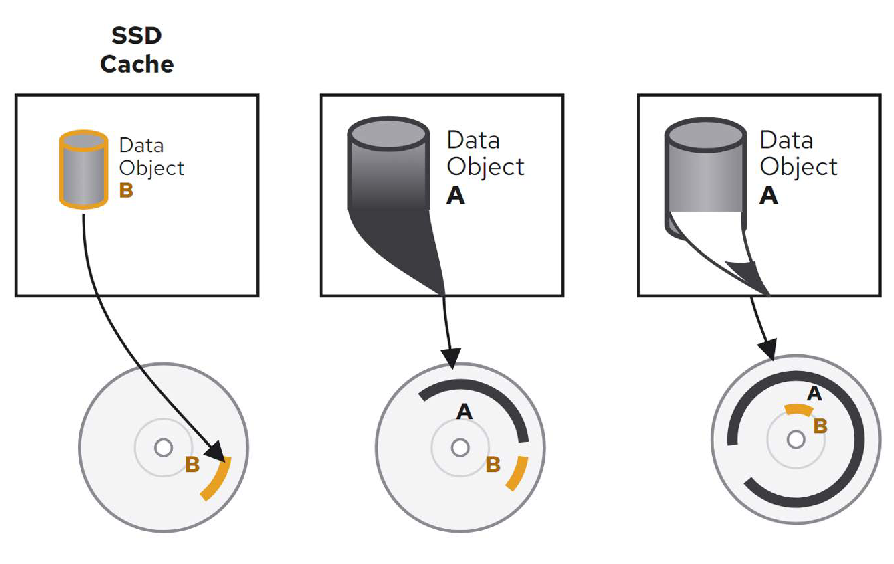 Figure 2-1. Data layout, caching, and prefetching algorithms.
When a client reads part of a data object, the VPOD uses its knowledge of the layout of the entire data object to prefetch the entire object, even if that object is placed on discontiguous disk sectors. This prefetching ability allows subsequent client read requests to be serviced at cache memory speeds. Write performance is also improved as writes are cached in the VPOD’s SSD, allowing applications to quickly return to processing while the data is written to disk in the background.
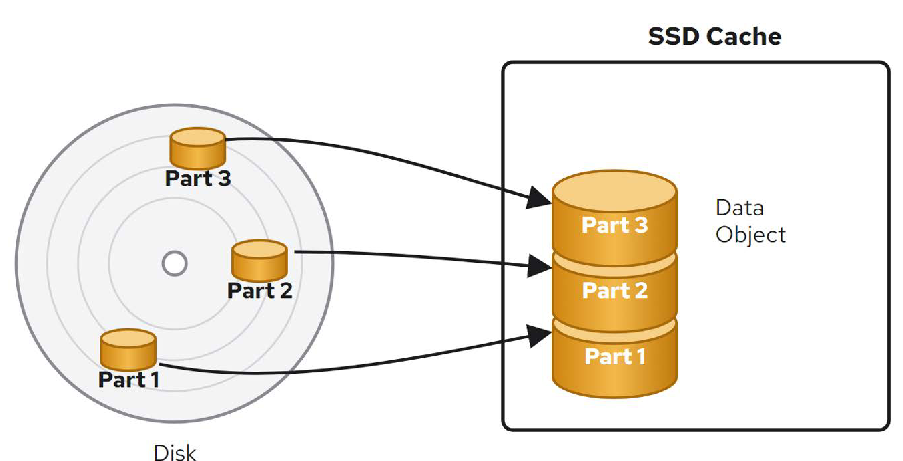 Figure 2-2. Data prefetching.
2.2 VDURA V5000 Certified Platform Hardware
VDURA V5000 Certified Platform™ hardware is an all-NVMe flash appliance engineered for AI and HPC pipelines that demand relentless GPU feed rates. Built on industry-standard servers, V5000 pairs flash performance with optional HDD capacity expansion, giving organizations a cost-balanced path from pilot to petabytes.
2.2.1 V5000 Director Nodes
V5000 Director Nodes anchor the VDURA control plane, running the flash-optimized VeLO Metadata Engine™ that coordinates billions of file operations and keeps AI pipelines saturated. Each compact server combines high-core CPUs, plentiful DRAM, and dual 200 Gb/s links for ultra-low-latency orchestration.
Instant secure-erase and optional self-encrypting drives safeguard data, while toolless service and redundant power maximize uptime for demanding AI and HPC deployments.
2.2.2 V5000 Flash Storage Nodes
Flash Storage Nodes form the performance-driven foundation of the data plane, dedicated exclusively to storing user data. Available in configurations of either all-NVMe flash for extreme performance or NVMe flash with HDD capacity expansion for high-performance, economical bulk storage, flash Storage Nodes deliver versatile and optimized infrastructure.
VPODs
Each VDURA Storage Node hosts 12 Virtualized Object Storage Devices™ (VPODs) rather than treating the entire server as a single failure domain.
VPODs are discrete, virtualized, and protected storage units that form the foundation of data storage. VPOD architecture ensures linear scalability and consistent parallel performance, accommodating thousands of nodes seamlessly within a single cluster.
V5000 Storage Nodes contain 12 NVMe SSD drives and can optionally be connected to a JBOD containing either 78 or 108 HDDs. Each VPOD in the Storage Node is associated with an SSD. If the Storage Node is a capacity expansion node, each VPOD will also be associated with several HDDs in the JBOD.
Each VPOD operates independently, but shares processor, memory, and network resources with the rest of the VPODs in the node.
In both PanActive Manager and PanCLI, a Storage Node appears as a combination of 12 VPODs, each with own IP and data serial node, plus one special item labeled “VPOD Container”, also with its own IP. The VPOD Container represents the hypervisor role and main OS of the Storage Node. It runs PanFS software that deploys, configures, and monitors VPODs and also publishes hardware monitoring data (JBOD, sensors, fans, etc.) to the realm.
Since each VDURA Storage Node hosts multiple VPODs, this architecture introduces a finer unit of failure isolation.
- The unit of failure is now one VPOD, not the physical server.
- More VPODs per node increases operational granularity and cluster flexibility.
- Device-level failures are isolated to a single VPOD, eliminating the risk of full node failure.
- Storage reconstruction only affects the failed VPOD’s component objects, not the entire node.
- Large files are striped across component objects in multiple VPODs using N+2 erasure coding (large files are striped across a set of VPODs plus additional VPODs into that stripe that store the P and Q data protection values of an N+2 erasure coding scheme).
- Small POSIX files are triple-replicated across VPODs.
If a VDURA Storage Node fails, the system must reconstruct only those VPODs that were on the failed node.
NOTE: VPOD (Virtualized Object Storage Device) is VDURA’s replacement for OSD (Object Storage Device). In this guide, you will notice that the terms OSD and VPOD are used interchangeably throughout PanActive Manager. For the purposes of the UI, they are interchangeable.
2.2.3 V5000 Capacity Expansion Enclosures
The VDURA V5000 system has two capacity expansion enclosure options: high-density enclosures containing 78 HDDs or ultra-dense enclosures with 108 HDDs. Both are 4U, 19” rackmount enclosures that come fully populated with HDDs. The 4U78 storage enclosure is ideal for one-meter deep racks, while the 4U108 fits 1.2-meter deep racks. V5000 storage enclosures support a wide range of HDDs. Both enclosure types also include two Titanium-level redundant power supplies.
2.3 VDURA Software
2.3.1 DirectFlow Client
Similar to massively parallel supercomputer architectures, VDURA DirectFlow software supports fully-parallel reads and writes from DirectFlow clients to OSDs without encountering bottlenecks. The DirectFlow software module is a loadable kernel module that transparently adds support for the VDURA file system protocols to Linux compute nodes. DirectFlow provides high-performance, high-fidelity POSIX semantics for large-scale distributed systems based on a cache consistency protocol with the VDURA metadata managers. In addition, there are specialized interfaces that optimize the large shared file workloads found in MPI-IO applications. For more information about the DirectFlow Client, see DirectFlow Client Support.
PanActive Manager
PanActive Manager provides an easy-to-use browser-based GUI to manage your VDURA system. The interface makes initial configuration, ongoing monitoring, report generation, and troubleshooting a smooth and understandable set of tasks. The SNMP interface allows integration of the storage system into enterprise data center management frameworks.
PanCLI
PanCLI is the VDURA Data Platform command-line interface. Administrators use it over ssh to monitor and manage the system from the command line instead of the PanActive Manager GUI.
PanCTL
PanCTL is the new command-line client for administering VDURA storage systems. It manages tenants, volumes, nodes, storage sets, and more from a terminal or script, using the same PanAPI backend as Vantage.
PanFS
PanFS is an object-based, parallel file system. Files are divided into chunks that are stored in different objects and accessed in parallel for performance and redundancy purposes. Data objects are containers for data and attributes that describe how the data fits into the overall distributed file system.
Files are striped across objects, and each file has its own map that defines the striping pattern. This allows different objects to have different striping patterns and provide different performance and redundancy characteristics. Because maps are just a small array of object identifiers and associated access capabilities, they are efficient to manage.
For example, small files and directory objects are mirrored so that they are cheap to create and cheap to update with small I/Os often associated with small files and directories. Large files are striped more widely using RAID on a per-file basis to provide redundancy with less capacity overhead than mirroring. Very large files use a two-level striping pattern that optimizes performance in large storage systems.
The storage map for a file can change dynamically to accommodate changes in the available storage resources. For example:
- If a storage node fails, component objects will automatically be reconstructed on alternate VPODs.
- The addition of new storage resources will result in automatic rebalancing of capacity so that all VPODs are loaded uniformly.
All data management is automatic and performed in the background while the system is online.
PanFS is built as a true parallel file system, engineered to handle the intense I/O demands of modern AI and HPC workloads. Each stored file is individually striped across many Storage Nodes, allowing each component piece of a file to be read and written in parallel, increasing the performance of accessing every file.
VDURA’s parallel architecture dramatically accelerates data access, significantly boosting performance and throughput. Unlike other enterprise systems which route data through limited head nodes, causing potential bottlenecks and requiring additional backend network infrastructure, VDURA’s DirectFlow Client communicates directly with all relevant Storage Nodes. Each compute server directly accesses the nodes holding the data, bypassing intermediary bottlenecks. Director Nodes manage metadata and coordinate system activity out-of-band, ensuring efficient data flow without interference or congestion.
This direct and parallel design eliminates traditional NAS hotspots, ensures predictable and scalable performance, and simplifies infrastructure by removing the need for a separate, costly backend network. VDURA architecture delivers seamless scalability, consistently high performance, and exceptional efficiency across every stage of the AI pipeline, from ingest and training to inference and long-term data retention.
PanFS delivers true linear scalability across both metadata and data services without compromise or complexity. AI workloads evolve fast, from early experimentation to scaled production across global clusters. Add Director Nodes to boost throughput for metadata-heavy tasks like model versioning and checkpoint tracking. Add Storage Nodes to scale bandwidth and capacity to support more training data, inference logs, or multi-tenant pipelines.
VDURA enables linear scalability, and growth is seamless and predictable. A 50 percent increase in Storage Nodes delivers 50 percent more throughput and capacity with no bottlenecks or architectural redesigns.
This flexibility is powered by VDURA’s fully virtualized, distributed software stack:
- VeLO Metadata Engine instances run in-memory across Director Nodes, scaling to billions of parallel metadata operations, perfect for high-frequency file creation, access pattern analysis, and rapid AI job cycles.
- VPODs manage user data in independently scalable units, each with its own erasure-coded stripe and logic, ideal for bursty checkpoint writes, long-term data lake retention, or active model training sets.
Together, these software-defined services form an intelligent, self-balancing system that grows effortlessly with the pipeline. Whether scaling GPU clusters, expanding training data, or retaining more checkpoints, VDURA adapts instantly.
To ensure that problems are detected before they cause a failure, PanActive Manager notifies administrators of impending failures, allowing them to identify and prevent problems before they affect the system. Systems can be monitored for disk and fan failures, as well as temperature and other environmental threats.
Realm Management
VDURA realm management software logically clusters Directors so that all Directors are fully engaged in workload processing.
To enable scalability, realm management is designed to allow hundreds of VDURA Directors to cluster together while evenly and effectively distributing the workload. Realm management provides the following advantages:
- Initial distribution and ongoing management of files is optimized across all hardware elements while minimizing interdependence.
- System operation is dynamically improved by adapting to changing client usage patterns and changes in file sizes.
- A highly available file system automatically adapts to Director failures.
For more information on realm management, see Realm Management.
Sentinel
VDURA Sentinel is a cloud-based fleet-monitoring console for VDURA storage systems. It gives customers a single place to see the health of every site and realm they run. From there they can review alerts, open support tickets, and capture and send diagnostics. An on-site agent reads each realm’s PanActive and Observability APIs read-only, and it sends a summarized snapshot to the cloud over outbound HTTPS only. Sharing is optional, and nothing connects back into the customer’s network. On V5000 systems the agent is built into PanFS from 12.x, and on legacy hardware it’s a standalone container.
Vantage
Vantage is VDURA’s newest system management UI and will become a full replacement for PanActive Manager in further releases.
VeLO
Velocity Layered Operations™ (VeLO) is a key value store used within the platform’s Director layer for handling high-performance metadata operations. Optimized for flash, VeLO supports the diverse range of workloads found in AI by supporting an infinitely-scalable number of VeLO instances in the same global namespace. Data is triplicated across each instance for superior durability.